How the New Austrian Tunnelling Method Changed Underground Construction — And Why Self-Drilling Anchors Matter
In This Article
The New Austrian Tunnelling Method (NATM) transformed underground construction by changing one fundamental idea: the surrounding rock should not be treated merely as a load to resist, but as part of the tunnel's support system. This article explores the evolution of NATM, its core engineering principles, and why self-drilling anchors have become one of the most reliable ground support solutions for tunnels excavated in weak, fractured, and water-bearing formations.
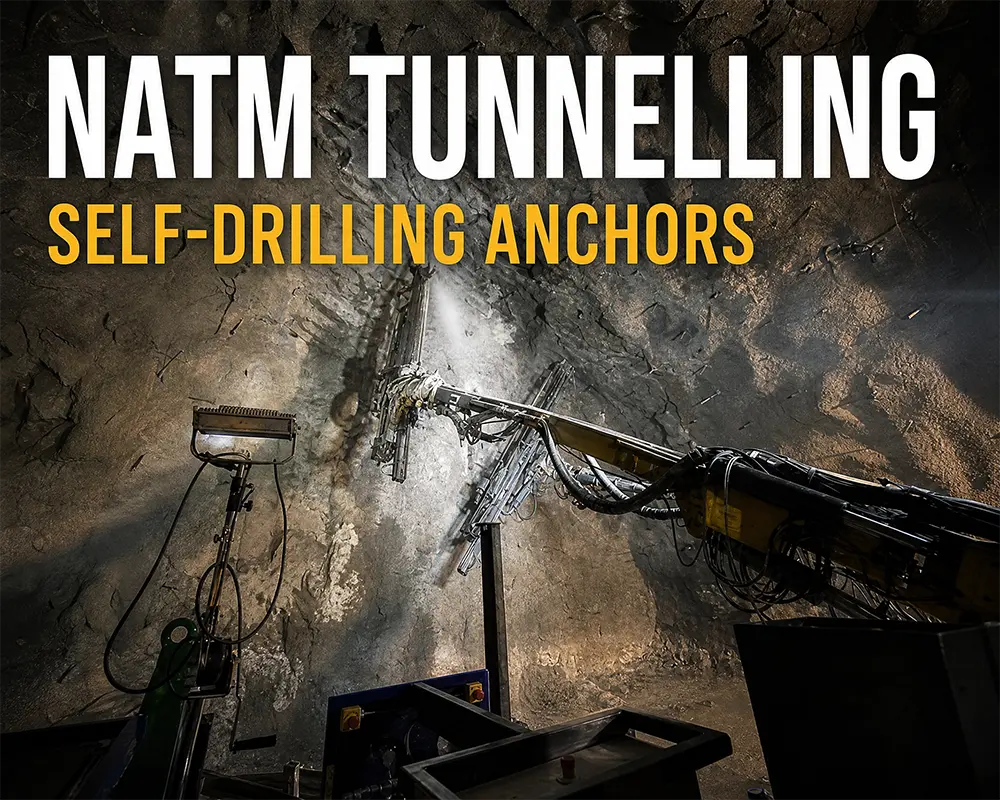
Early ground support is a cornerstone of the New Austrian Tunnelling Method. By installing self-drilling anchors immediately after excavation, engineers help preserve the natural load-bearing capacity of the surrounding rock before excessive deformation can occur.
Contents
- Into the Mountain: Where Every Minute Matters
- Before NATM: When the Rock Was Treated as the Enemy
- The Birth of NATM: When Engineers Started Working With the Rock
- The Four Principles That Make NATM Work
- Why Self-Drilling Anchors Changed Underground Construction
- Where Self-Drilling Anchors Excel
- Why Timing Matters More Than Strength
- Practical Resources for Tunnel Engineers and Project Teams
- Frequently Asked Questions
- Looking Beyond the Tunnel
Into the Mountain: Where Every Minute Matters
Imagine standing at the face of a newly excavated tunnel.
The blast has just ended. Dust still hangs in the air. Fresh fractures spread across the exposed rock, loose fragments occasionally fall from the tunnel crown, and groundwater begins to seep through newly opened joints. The mountain is constantly changing, even though the excavation equipment has already stopped.
For tunnel engineers, this is one of the most critical moments of the entire construction cycle.
Every minute without support allows the surrounding rock to deform. Every delay increases the risk that small cracks will grow into larger instabilities. The challenge is not simply building a stronger tunnel—it's preserving the natural strength that already exists inside the rock mass.
Decades ago, engineers approached this problem very differently. The common solution was to install heavier steel ribs and thicker concrete linings as quickly as possible. The surrounding ground was treated primarily as a source of pressure that permanent structures had to resist.
Modern underground construction follows a fundamentally different philosophy.
"The surrounding rock is not the enemy—it is part of the support system."
This single idea reshaped tunnel engineering and eventually became the foundation of the New Austrian Tunnelling Method (NATM). Instead of forcing artificial structures to carry the entire load, NATM seeks to preserve, mobilize, and reinforce the natural load-bearing capacity of the surrounding rock through controlled excavation, early support, and continuous monitoring. :contentReference[oaicite:0]{index=0}
Achieving this philosophy in difficult ground requires support systems that can be installed immediately after excavation, even when boreholes are unstable or groundwater is present. This is where the self-drilling anchor system has become an essential technology in modern tunnelling.
Unlike conventional rock bolts, a self-drilling anchor uses a hollow anchor bar as both the drill rod and the permanent reinforcement. Drilling, flushing, and grouting are completed in one continuous operation, reducing installation time while improving anchorage performance in fractured and water-bearing formations.
Engineering Insight
Many people think NATM is simply another tunnel construction method. In reality, experienced engineers regard it as a design philosophy. The support system—including shotcrete, rock bolts, lattice girders, and drill bits used for ground reinforcement—is continuously adapted according to the measured behaviour of the surrounding rock rather than following a fixed design from the first day of excavation. :contentReference[oaicite:1]{index=1}
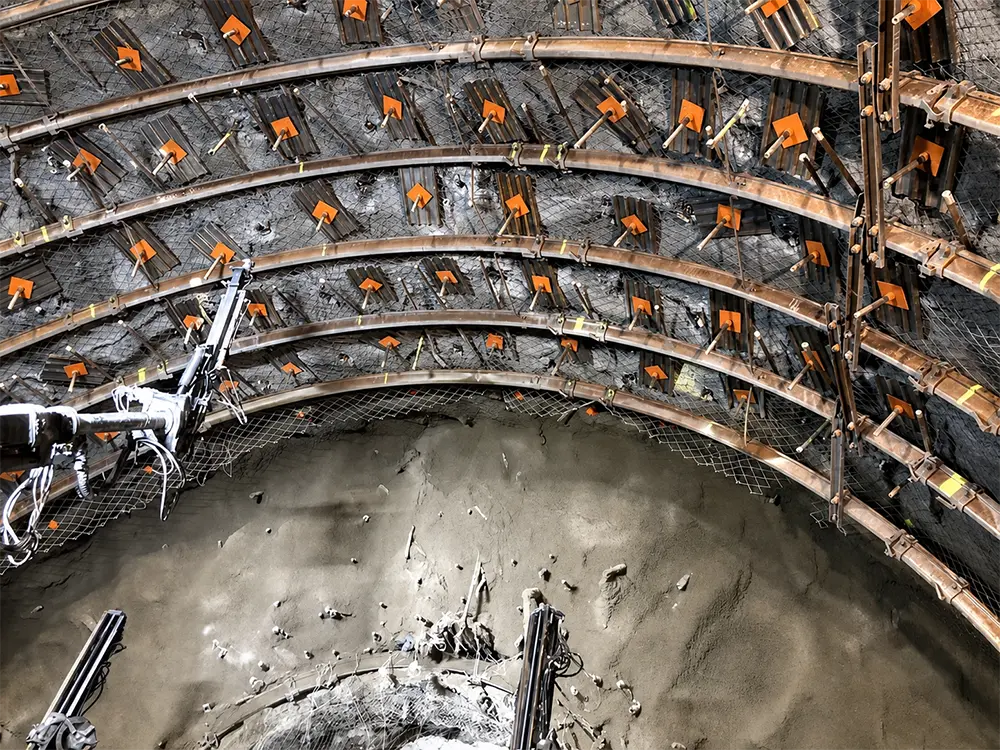
Installing self-drilling anchors immediately after excavation helps preserve the natural strength of the surrounding rock before excessive deformation develops—a key principle of the New Austrian Tunnelling Method.
But tunnel engineering did not always follow this philosophy.
To understand why NATM revolutionized underground construction, we first need to look at how engineers once viewed the rock surrounding a tunnel—and why that thinking eventually changed.
Before NATM: When the Rock Was Treated as the Enemy
Long before the New Austrian Tunnelling Method (NATM) became the standard for underground construction, tunnel engineering was guided by a very different philosophy.
The surrounding rock was viewed primarily as a source of pressure. Once a tunnel was excavated, engineers assumed the rock had lost its stability and that the entire load needed to be carried by the tunnel lining itself.
The solution seemed obvious: build stronger support.
Massive concrete linings, heavy steel ribs, and rigid support systems became common practice. The stronger the support looked, the safer the tunnel was believed to be.
Traditional Engineering Mindset
The surrounding rock was considered a load acting on the tunnel. The support structure was expected to resist that load almost entirely on its own.
For many projects, this approach worked reasonably well. However, engineers gradually noticed a recurring problem. Even after installing stronger supports, tunnels excavated in weak or highly fractured ground often continued to deform. In some cases, increasing the stiffness of the support system actually concentrated stresses instead of relieving them.
The real challenge was not simply the strength of the lining—it was the behaviour of the surrounding rock mass.
As underground projects expanded into deeper mountains and more complex geological conditions throughout Europe after the Second World War, engineers began asking a different question:
What if the surrounding rock could help support the tunnel instead of being treated only as a load?
That question marked the beginning of a major shift in underground engineering. Instead of designing tunnels to resist the mountain, engineers started looking for ways to preserve the natural strength of the rock and allow it to participate in carrying the load.
This new way of thinking laid the foundation for what would later become the New Austrian Tunnelling Method (NATM)—a philosophy that transformed tunnel construction around the world by treating the surrounding rock as an active structural component rather than a passive source of pressure.
Engineering Insight
One of the most significant breakthroughs introduced by NATM was not a new material or a new machine—it was a new understanding of rock mechanics. Engineers realized that preserving the integrity of the surrounding ground could often provide greater long-term stability than simply increasing the thickness of the tunnel lining.
This idea fundamentally changed tunnel engineering.
The next question was how to transform this philosophy into a practical construction method—one that could stabilize the surrounding rock quickly enough before it lost its natural strength.
The Birth of NATM: When Engineers Started Working With the Rock
By the 1950s, European engineers had begun to question one of the oldest assumptions in tunnel construction: Should the support structure really carry the entire load?
Experience from hundreds of tunnels suggested otherwise. In many cases, the surrounding rock still possessed considerable strength after excavation. If excessive disturbance could be avoided and support installed at the right moment, the rock mass itself could become part of the tunnel's structural system.
This idea became the foundation of the New Austrian Tunnelling Method (NATM), developed through the pioneering work of Austrian engineer Ladislaus von Rabcewicz and later refined by many European researchers and contractors.
Engineering Insight
NATM is often described as a construction method, but many engineers consider it a design philosophy. Instead of assuming the ground conditions in advance, NATM relies on continuous observation, field measurements, and timely adjustments to excavation and support as the surrounding rock responds during construction.
Rather than resisting the mountain with increasingly rigid structures, NATM seeks to preserve the natural strength of the surrounding rock. The objective is not to eliminate all movement, but to allow a controlled amount of deformation so that the rock can develop its own stable load-bearing arch.
This concept fundamentally changed the role of tunnel support.
Instead of acting as an independent structure, shotcrete, steel arches, and anchors work together with the surrounding rock to create a single integrated support system. Every component has a specific purpose, but none is intended to carry the entire load alone.
The goal of NATM is not to stop the rock from moving—it is to control that movement before it becomes unstable.
This philosophy also explains why the timing of support is often more important than the amount of support. Installing reinforcement immediately after excavation helps maintain the integrity of the rock mass, allowing it to remain an active part of the tunnel rather than becoming a detached load acting on the lining.
Among today's reinforcement technologies, the self-drilling anchor system is particularly well suited to this philosophy. Because drilling, flushing, grouting, and anchoring are completed in a single operation, the surrounding ground can be stabilized much sooner than with conventional multi-step installation methods.
Depending on the geological conditions, engineers may choose either an R-thread hollow bar or a T-thread hollow bar. Both systems are designed to transfer loads efficiently after grouting while maintaining excellent performance in weak or fractured formations.
Key Takeaway
The greatest innovation of NATM was not a new support material—it was a new understanding of how tunnels behave. By allowing the surrounding rock and the support system to work together, engineers could build safer, more economical tunnels while reducing unnecessary structural loads.
A new philosophy, however, still required practical engineering rules.
How could engineers consistently preserve the strength of the surrounding rock under vastly different geological conditions? NATM answered this question with four fundamental principles that continue to guide tunnel construction today.

The Four Principles That Make NATM Work
Although every tunnel is different, the New Austrian Tunnelling Method is built on four engineering principles that remain remarkably consistent. Whether constructing a metro tunnel beneath a city or excavating through fractured mountain rock, these principles help engineers preserve the strength of the surrounding ground while minimizing construction risks.
Together, they form the foundation of modern underground construction.
① Minimize Disturbance to the Rock Mass
Every excavation changes the stress distribution within the surrounding rock. Excessive blasting, unnecessary overbreak, or repeated disturbance can damage the rock mass before support is even installed.
For this reason, NATM emphasizes controlled excavation techniques such as smooth blasting, sequential excavation, or mechanical excavation whenever practical. The objective is simple: preserve as much of the rock's natural strength as possible.
The less damage created during excavation, the more load the surrounding rock can continue to carry after support is installed.
② Install Support as Early as Possible
Time is one of the most valuable resources in tunnel construction.
Immediately after excavation, the surrounding rock begins to deform. Early support limits this deformation before it develops into instability, allowing the rock mass to retain its natural load-bearing capacity.
This is one of the reasons why the self-drilling anchor system has become increasingly popular in NATM projects. Because drilling, flushing, grouting, and anchoring are completed in one continuous operation, reinforcement can be installed much sooner than with conventional rock bolts.
The complete system normally includes a hollow anchor bar, sacrificial drill bit, couplers, anchor nuts, and bearing plates, all working together to transfer loads efficiently into the surrounding ground.
③ Monitor the Ground Continuously
Unlike traditional construction methods that rely entirely on the original design, NATM treats every tunnel as a continuously evolving engineering project.
Survey data, convergence measurements, groundwater observations, and rock deformation are collected throughout construction. These measurements allow engineers to adjust excavation sequences, reinforcement patterns, and support timing according to the actual behaviour of the ground.
Many experienced tunnel engineers describe NATM as an observational method rather than simply a construction method. Monitoring is considered just as important as excavation itself.
④ Close the Support Ring Quickly
As excavation progresses, individual support elements gradually become part of a continuous structural ring. Closing this ring allows loads to be redistributed around the tunnel instead of concentrating at isolated locations.
Shotcrete, reinforcement, steel arches, and anchor systems work together to create a flexible support structure that moves with the surrounding rock while preventing excessive deformation.
This balanced interaction between the rock mass and the support system is one of the defining characteristics of NATM and one of the reasons it has become the preferred construction philosophy for many underground projects worldwide.
Key Takeaway
The success of NATM does not depend on stronger support—it depends on smarter support. By minimizing disturbance, installing reinforcement early, monitoring continuously, and rapidly forming a complete support ring, engineers allow the surrounding rock and the support system to work together as a single structural unit.
These principles explain how NATM works.
The next question is even more practical: Why have self-drilling anchors become one of the preferred reinforcement systems for implementing these principles in difficult ground?

Why Self-Drilling Anchors Changed Underground Construction
The principles of NATM are straightforward: preserve the surrounding rock, install support early, and continuously monitor ground behaviour.
In practice, however, achieving these objectives depends on one critical factor:
Can the support system be installed before the ground loses stability?
In competent rock, conventional rock bolts often perform well. A borehole is drilled, cleaned, the anchor is inserted, and grout is injected to create a permanent bond.
But many tunnel projects are not excavated in competent rock.
Engineers frequently encounter highly fractured formations, fault zones, weathered rock, loose gravel, or water-bearing ground. Under these conditions, an open borehole may begin to collapse almost immediately after drilling.
The Challenge
- Boreholes collapse before the anchor can be installed.
- Groundwater washes grout away.
- Repeated drilling delays construction.
- Loose formations make accurate installation difficult.
- Every delay allows additional rock deformation.
For NATM, these delays are more than an inconvenience—they directly contradict the principle of early support. Every minute spent re-drilling or cleaning collapsed boreholes increases the opportunity for the surrounding rock to deform before reinforcement becomes effective.
The One-Step Solution
A self-drilling anchor system was developed specifically to overcome these challenges.
Instead of treating drilling and anchoring as separate operations, the hollow anchor bar itself functions as the drill string and remains in the ground as the permanent reinforcement after installation.
The process is remarkably efficient:
Installation Sequence
① Drill
↓
② Flush Cuttings Through the Hollow Bar
↓
③ Grout Under Pressure
↓
④ Permanent Reinforcement
Because the borehole is never left unsupported, the risk of collapse is significantly reduced. Drilling, flushing, grouting, and anchoring become one continuous operation instead of several separate construction stages.
The system typically consists of a sacrificial drill bit, a threaded hollow bar, optional couplers for extending anchor length, and a combination of bearing plates and anchor nuts to transfer loads safely into the support structure.
The greatest advantage of a self-drilling anchor is not that it replaces a rock bolt—it eliminates the vulnerable period between drilling and reinforcement.
Why This Matters for NATM
This characteristic makes self-drilling anchors particularly compatible with the philosophy of NATM.
By reducing installation time and allowing immediate grouting, the surrounding rock is reinforced while it still retains much of its natural strength. Instead of reacting to instability after it develops, engineers can stabilize the ground before excessive deformation occurs.
This is especially valuable in tunnel excavation, mining, slope stabilization, and micropile construction, where unpredictable geological conditions demand rapid and reliable reinforcement.
Engineering Insight
Many engineers view self-drilling anchors not simply as another type of rock bolt, but as a practical way to implement NATM in weak and unstable ground. The technology supports the method's most important objective: installing effective reinforcement before the surrounding rock loses its ability to contribute to the tunnel's stability.
Not every project faces the same geological challenges.
So where do self-drilling anchors provide the greatest engineering advantage? In the next section, we'll examine the ground conditions where they outperform conventional reinforcement methods.
Conventional Rock Bolt vs. Self-Drilling Anchor
Both systems are widely used in underground construction, but their installation procedures differ significantly—especially in weak or unstable ground.
Engineering Insight
The primary advantage of a self-drilling anchor system is not simply faster drilling. By combining drilling, flushing, grouting, and permanent reinforcement into a single continuous operation, it minimizes the time during which the surrounding ground remains unsupported. This makes the system particularly valuable in fractured rock, weathered formations, and water-bearing ground where conventional boreholes may become unstable before anchor installation is complete.
Anatomy of a Self-Drilling Anchor System
A self-drilling anchor system consists of several engineered components that work together as a complete reinforcement solution. Each component performs a specific function during drilling, grouting, and long-term load transfer.
Drill Bit
The sacrificial drill bit cuts through soil or rock and remains at the end of the anchor after installation. Different bit designs are selected according to geological conditions.
Rock penetration
Hollow Bar
The hollow threaded bar serves as the drill string during installation and becomes the permanent reinforcement after pressure grouting.
Drilling + Grouting + Reinforcement
Coupler
Couplers securely connect two hollow bars, allowing longer anchor lengths without compromising load transfer efficiency.
Bar extension
Bearing Plate
The bearing plate distributes the anchor load over the ground surface or shotcrete lining, helping prevent localized stress concentration.
Load distribution
Anchor Nut
The anchor nut locks the bearing plate against the support surface, ensuring that loads are effectively transferred into the reinforcement system.
Load locking
How the System Works Together
Unlike conventional rock bolt systems, a self-drilling anchor integrates drilling, flushing, grouting, and reinforcement into a single installation process. Each component contributes to a specific stage of this workflow:
Drill Bit → Hollow Bar → Coupler (when longer anchors are required) → Bearing Plate + Anchor Nut
Together, these components form a complete reinforcement system that supports efficient installation and reliable load transfer in challenging ground conditions.
Where Self-Drilling Anchors Excel: Five Ground Conditions That Challenge Conventional Rock Bolts
Figure 5. Ground Conditions Where Self-Drilling Anchors Perform Best
Self-drilling anchor systems are specifically designed for geological conditions where maintaining an open borehole is difficult or impossible. The matrix below summarizes the most common challenging ground conditions and explains why the system performs effectively.
| Ground Condition | Typical Challenge | Why Self-Drilling Anchors Work |
|---|---|---|
| 🪨 Highly Fractured Rock | Boreholes collapse or become unstable after drilling. | The hollow bar remains in place throughout installation, reducing borehole instability. |
| 🌊 Water-Bearing Ground | Groundwater washes away grout and weakens boreholes. | Pressure grouting through the hollow bar improves grout penetration and bonding. |
| ⛰️ Fault Zones | Crushed rock and clay create unpredictable drilling conditions. | One-step installation minimizes exposure of unsupported ground. |
| 🟤 Loose Sand & Gravel | Granular soils collapse immediately after drill rod removal. | No separate borehole is required because the hollow bar becomes the permanent reinforcement. |
| 🟫 Weathered Rock | Alternating soft and hard layers reduce drilling efficiency. | Continuous installation improves stability across variable formations. |
Engineering Insight
The value of a self-drilling anchor system is most evident where conventional installation methods become unreliable. By eliminating the need for a separate unsupported borehole, the system enables rapid reinforcement in geological conditions that often delay or complicate traditional rock bolt installation.
Not every tunnel is excavated through strong, competent rock.
In reality, underground projects often encounter changing geology within just a few metres. A stable rock formation may suddenly transition into fractured zones, weathered material, or water-bearing ground, creating conditions where conventional rock bolt installation becomes increasingly difficult.
These are precisely the situations where self-drilling anchor systems demonstrate their greatest engineering value.
Rather than being designed for only one type of project, they are intended for the ground conditions that create the greatest challenges during excavation.
1. Highly Fractured Rock
Closely spaced joints and broken rock blocks often prevent conventional boreholes from remaining stable long enough for anchor installation.
Because the hollow anchor bar remains inside the borehole throughout drilling, flushing, and grouting, self-drilling anchors greatly reduce the risk of borehole collapse while providing immediate reinforcement.
2. Fault Zones
Faults frequently contain crushed rock, clay seams, and irregular groundwater flow. These conditions increase drilling difficulties and often require rapid stabilization before excavation can continue safely.
The one-step installation process allows support to be installed without exposing an unsupported borehole, making self-drilling anchors well suited for these unpredictable environments.
3. Water-Bearing Ground
Groundwater is one of the most common causes of installation problems for conventional anchors. Flowing water may wash away grout or destabilize the borehole before reinforcement can be completed.
Pressure grouting through the hollow bar helps fill fractures while improving the bond between grout and the surrounding rock, making the system particularly effective in water-bearing formations.
4. Loose Sand and Gravel
Granular soils rarely remain open after drilling. In many cases, the borehole begins collapsing immediately once the drill string is withdrawn.
Since the hollow bar itself becomes the permanent reinforcement, no temporary unsupported borehole is created, significantly improving installation reliability.
5. Weathered Rock
Weathered formations often contain alternating layers of soft and hard material, producing uneven drilling conditions and variable rock quality.
Self-drilling anchors provide continuous reinforcement across these changing geological conditions while minimizing delays caused by repeated drilling operations.
Engineering Insight
The greatest advantage of a self-drilling anchor is not simply faster installation. It is the ability to maintain continuous ground support in situations where conventional installation methods may be interrupted by collapsing boreholes, groundwater, or unstable formations.
From Challenging Ground to Successful Projects
These geological conditions are encountered every day in tunnel construction, mining, slope stabilization, and micropile projects around the world. You can explore real-world examples on our Tunnel Projects page, where self-drilling anchor systems have been used to improve excavation safety and construction efficiency under demanding ground conditions.
Selecting the right anchor system is only part of the solution. Choosing the appropriate thread profile, accessories, and installation configuration is equally important for achieving reliable long-term performance.
Not all self-drilling anchor systems are identical.
In the next section, we'll compare R-thread and T-thread systems, explain their differences, and show how engineers select the most suitable configuration for different ground conditions.
Why Timing Matters More Than Strength
When discussing tunnel support, many people naturally focus on one question:
"How strong is the anchor?"
It is certainly an important question—but it is not always the most important one.
In NATM, engineers are often more concerned with when reinforcement becomes effective than with its ultimate load capacity.
Every minute after excavation, the surrounding rock begins to respond to the redistribution of in-situ stresses. Small deformations are expected and even beneficial, but excessive movement may open joints, loosen rock blocks, and reduce the natural strength that NATM seeks to preserve.
Engineering Insight
In many underground projects, reducing deformation is more effective than repairing damage after it has already occurred. This is why NATM places such a strong emphasis on early reinforcement.
Conventional rock bolts often require several independent operations:
- Drill the borehole
- Withdraw the drill string
- Clean the hole
- Insert the anchor
- Inject grout
Each additional step creates an opportunity for unstable ground to deteriorate before permanent reinforcement is installed.
A self-drilling anchor system simplifies this process by combining drilling, flushing, grouting, and anchoring into one continuous operation.
The result is not simply a faster installation sequence. More importantly, the surrounding ground spends less time unsupported, allowing engineers to preserve the rock mass while it still contributes to the stability of the excavation.
The earlier effective support is installed, the greater the opportunity to preserve the natural strength of the surrounding rock.
This philosophy explains why self-drilling anchors have become widely adopted not only in NATM tunnels, but also in mining, slope stabilization, and micropile construction—projects where geological conditions can change rapidly and immediate reinforcement is essential.
Field Note
Engineers rarely choose self-drilling anchors simply because they install faster. They choose them because the system reduces the interval between excavation and effective ground support—an advantage that becomes increasingly valuable in fractured, weathered, or water-bearing formations.
Support is only one part of a successful underground project.
Efficient logistics also matter. Selecting the right anchor length, thread type, and shipment quantity can significantly improve project planning and reduce transportation costs.
Practical Resources for Tunnel Engineers and Project Teams
Selecting the right self-drilling anchor system is only part of a successful underground project. Engineers, procurement teams, and contractors also need practical tools that simplify planning, material selection, and logistics.
To support these day-to-day engineering tasks, we've developed several free resources based on common questions from tunnel and geotechnical projects.
Calculate How Many Self-Drilling Anchors Fit in a 20GP Container
Shipping costs are an important part of every international project. Because self-drilling anchor bars are available in different diameters, lengths, and thread profiles, estimating container capacity manually can be time-consuming.
Our free Self-Drilling Anchor 20GP Container Loading Calculator allows you to estimate loading quantities for different hollow bar specifications in just a few seconds.
Why Use the Calculator?
- Estimate container loading capacity instantly
- Compare different hollow bar sizes
- Improve quotation accuracy
- Reduce logistics planning time
- Avoid underloading or overweight shipments
Explore Real Tunnel Projects
Engineering decisions are best supported by real-world experience.
If you'd like to see how self-drilling anchor systems are used in underground construction, visit our Tunnel Projects page. It features representative applications in tunnelling and ground support, demonstrating how different geological conditions influence reinforcement strategies.
From transportation tunnels to challenging ground stabilization projects, these examples illustrate how NATM principles are applied in practice using modern self-drilling anchor systems.
Further Reading
If you'd like to learn more about individual system components, the following technical guides provide additional information:
Understanding the philosophy behind NATM is important.
Applying that knowledge correctly is what ultimately determines the success of an underground project.
Frequently Asked Questions About NATM and Self-Drilling Anchors
The following questions are among the most common topics discussed by tunnel engineers, contractors, and procurement teams involved in underground construction projects.
Is NATM a construction method or a design philosophy?
Although the name suggests a construction method, most engineers regard the New Austrian Tunnelling Method (NATM) as a design philosophy. Instead of relying on a fixed support design, NATM emphasizes observing the behavior of the surrounding rock during excavation and adjusting support measures accordingly. The objective is to preserve the natural strength of the rock mass and allow it to work together with the support system.
Why are self-drilling anchors widely used in NATM tunnels?
NATM requires support to be installed as early as possible after excavation. In weak or fractured ground, conventional boreholes may collapse before anchors can be installed. A self-drilling anchor system combines drilling, flushing, grouting, and anchoring into one continuous operation, making it possible to stabilize the surrounding ground much earlier and reduce the risk of borehole collapse.
Can self-drilling anchors replace conventional rock bolts?
Not necessarily. Conventional rock bolts remain an excellent solution in competent, stable rock where boreholes can be drilled and maintained without difficulty. Self-drilling anchors are generally preferred in weak, fractured, weathered, or water-bearing formations where maintaining an open borehole becomes challenging. The choice depends on geological conditions rather than one system being universally better than the other.
What is the difference between a hollow bar anchor and a solid rock bolt?
A hollow bar anchor serves two purposes: it functions as the drill string during installation and remains in the ground as permanent reinforcement. A conventional solid rock bolt requires a completed borehole before installation. This integrated design allows self-drilling anchors to simplify installation while enabling pressure grouting directly through the center of the anchor bar.
When should R-thread or T-thread hollow bars be selected?
Both systems are widely used in self-drilling anchor applications, but they are designed for different engineering preferences and project specifications. You can learn more about their characteristics in our guides to R-thread hollow bars and T-thread hollow bars, where their profiles, applications, and advantages are explained in greater detail.
Can self-drilling anchors be used outside tunnel construction?
Yes. Although they are widely associated with NATM tunnelling, self-drilling anchors are also used for slope stabilization, mining, foundation reinforcement, retaining structures, and micropile construction. Their ability to provide reliable reinforcement in unstable ground makes them suitable for many geotechnical applications beyond tunnels.
How can I estimate the number of anchor bars that fit in a shipping container?
Container loading depends on the anchor diameter, length, and total shipment weight. To simplify planning, you can use our free Self-Drilling Anchor 20GP Container Loading Calculator, which provides quick estimates for different hollow bar specifications.
Looking Beyond the Tunnel
Imagine returning to the tunnel a few months after excavation began.
The dust has settled. Fresh shotcrete now covers the tunnel walls. The surrounding rock has reached a new state of equilibrium, and the self-drilling anchors installed during the earliest stages of excavation are now permanently bonded within the rock mass.
What was once an exposed excavation face has become part of a safe and stable underground structure.
This transformation is not the result of a single product or a single construction technique. It is the result of a philosophy that changed the way engineers understand underground construction.
The New Austrian Tunnelling Method demonstrated that the surrounding rock should not simply be resisted—it should be understood, protected, and allowed to participate in supporting the tunnel itself.
The greatest achievement of NATM was not stronger support systems—it was a better understanding of how the ground itself contributes to long-term stability.
Modern reinforcement technologies have made this philosophy even more practical. By combining drilling, flushing, grouting, and permanent reinforcement into a single continuous operation, self-drilling anchor systems help engineers implement NATM principles more efficiently, particularly in fractured, weathered, and water-bearing ground where conventional installation methods may struggle.
Whether you're designing a transportation tunnel, stabilizing a slope, constructing a micropile foundation, or planning an underground mining project, understanding the interaction between the ground and the support system remains one of the most important factors in achieving safe and economical construction.
Continue Exploring
Interested in learning more about self-drilling anchor technology? Explore our technical resources below:
- Self-Drilling Hollow Bar Anchor System
- R-Thread Hollow Bars
- T-Thread Hollow Bars
- Self-Drilling Anchor Drill Bits
- Anchor Couplers
- Bearing Plates
- Anchor Nuts
- Tunnel Project References
- 20GP Container Loading Calculator
Whether you're an engineer, contractor, distributor, or project owner, these resources are designed to help you better understand modern self-drilling anchor systems and their applications in underground construction.

More Articles
 https://i0.wp.com/rayonsda.com/wp-content/uploads/2026/10/Self-Drilling-Anchor-Hollow-Bar-System.webp?fit=1000%2C800&ssl=1
800
1000
RY
https://rayonsda.com/wp-content/uploads/2026/03/Rayon-Logo-300x138.png
RY2026-10-19 06:36:452026-10-20 02:13:02Self Drilling Anchor HOLLOW BAR System
https://i0.wp.com/rayonsda.com/wp-content/uploads/2026/10/Self-Drilling-Anchor-Hollow-Bar-System.webp?fit=1000%2C800&ssl=1
800
1000
RY
https://rayonsda.com/wp-content/uploads/2026/03/Rayon-Logo-300x138.png
RY2026-10-19 06:36:452026-10-20 02:13:02Self Drilling Anchor HOLLOW BAR System https://i0.wp.com/rayonsda.com/wp-content/uploads/2026/09/ground-anchor-cover.webp?fit=1000%2C800&ssl=1
800
1000
RY
https://rayonsda.com/wp-content/uploads/2026/03/Rayon-Logo-300x138.png
RY2026-09-09 06:19:592026-09-09 06:20:02Ground Anchor Types and Installation Technologies
https://i0.wp.com/rayonsda.com/wp-content/uploads/2026/09/ground-anchor-cover.webp?fit=1000%2C800&ssl=1
800
1000
RY
https://rayonsda.com/wp-content/uploads/2026/03/Rayon-Logo-300x138.png
RY2026-09-09 06:19:592026-09-09 06:20:02Ground Anchor Types and Installation Technologies https://i0.wp.com/rayonsda.com/wp-content/uploads/2026/06/galvanized_anchor_cover.webp?fit=1000%2C800&ssl=1
800
1000
RY
https://rayonsda.com/wp-content/uploads/2026/03/Rayon-Logo-300x138.png
RY2026-06-30 06:56:502026-06-30 06:56:52
https://i0.wp.com/rayonsda.com/wp-content/uploads/2026/06/galvanized_anchor_cover.webp?fit=1000%2C800&ssl=1
800
1000
RY
https://rayonsda.com/wp-content/uploads/2026/03/Rayon-Logo-300x138.png
RY2026-06-30 06:56:502026-06-30 06:56:52
