Ground Anchor Types and Installation Technologies
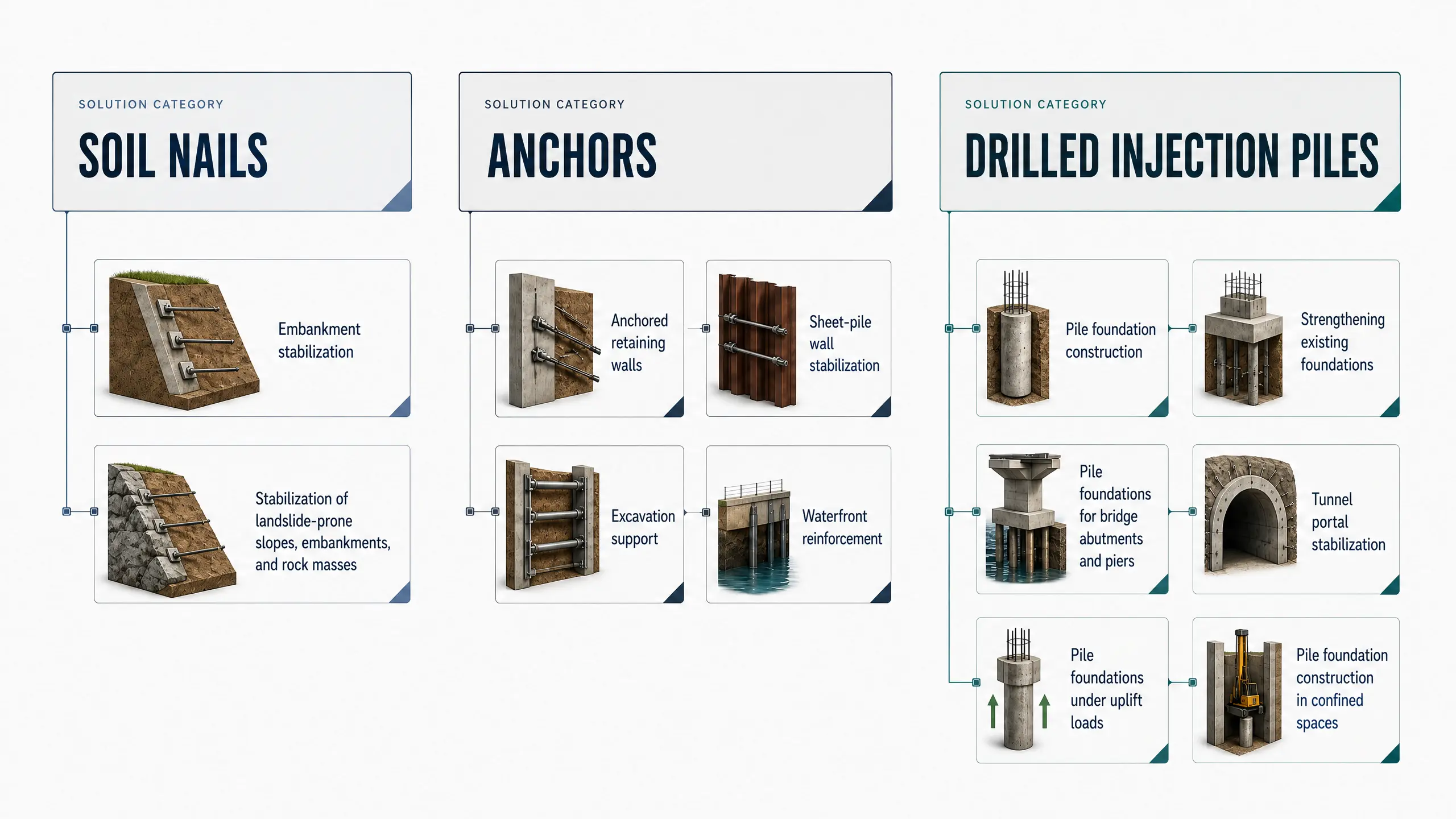
Ground anchors are specialized fastening and ground-reinforcement elements that, when properly designed and installed, help hold structures in position and control displacement or deformation. Their purpose is to transfer tensile loads from a structure into suitable surrounding soil or rock, thereby contributing to structural stability and safety.
Traditional solutions such as massive retaining walls or deep foundations are not always practical, especially for large excavations in confined spaces, multi-story buildings, bridge structures, and other projects where working space is limited. Ground anchor technologies can therefore help optimize construction timelines, reduce structural work, and provide a reliable means of ground support.
Main Types of Ground Anchors
Each construction project has its own requirements for embedment depth, load-bearing capacity, ground conditions, and service life. Understanding the main ground anchor types helps engineers and contractors select a suitable system for the application.
Rod Anchors
This is a classic option in which the load-bearing element is a metal rod, such as a reinforced bar or threaded steel bar. The root portion may use plate-shaped extensions, blades, or a compacted concrete or grout root. Rod anchors are used for moderate loads and are often applied to secure shallow retaining structures and other ground-support elements.
Rope (Strand) Anchors
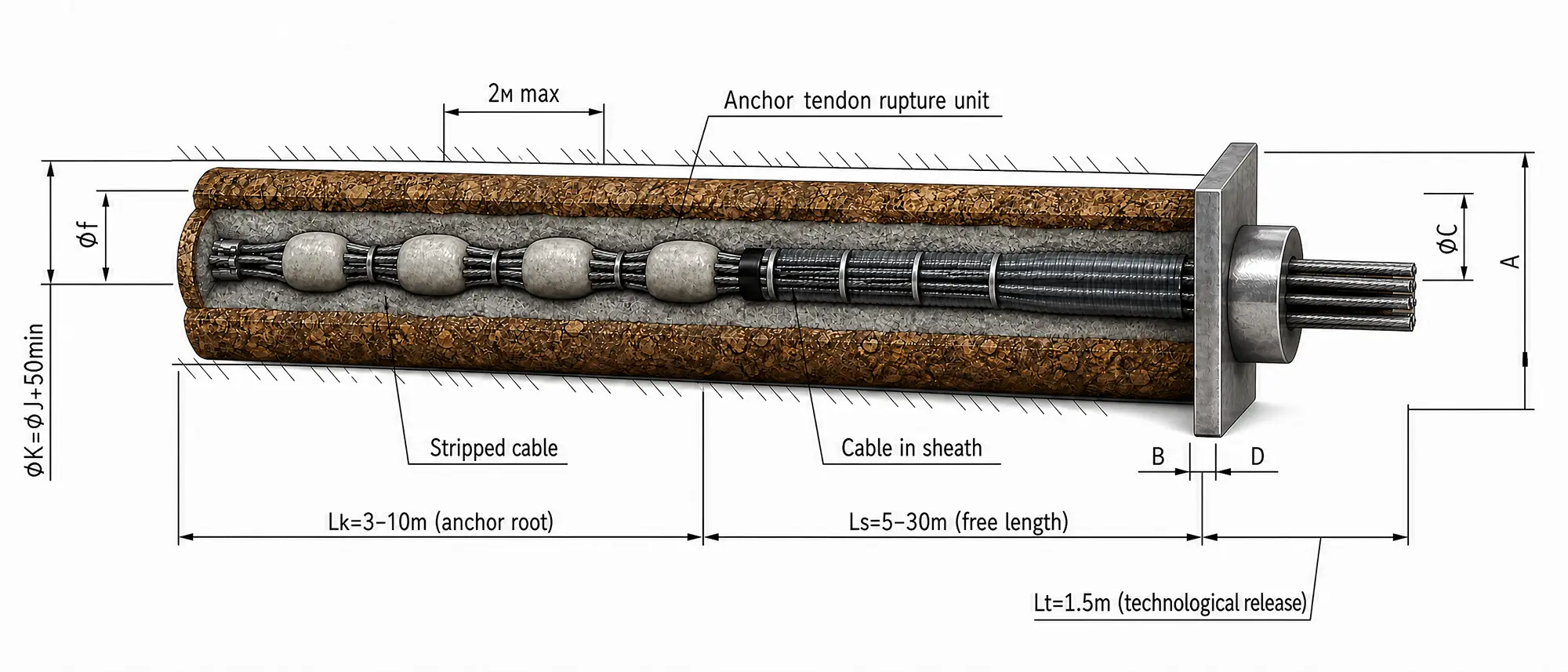
This type uses steel cables made of multiple wire strands. The structure is highly flexible and can withstand significant pull-out loads, making strand anchors suitable for retaining walls, deep excavations, and other civil engineering structures where substantial tensile capacity is required.
Self-Expanding Anchors
The root section of this type is equipped with deployable blades or plates. During installation, they remain folded; after the desired depth is reached, they expand and become transverse to the anchor axis. This design can simplify installation and improve the mechanical anchorage between the anchor and the surrounding ground.
Screw Anchors
Screw anchors essentially consist of a metal rod with one or more helical blades that is screwed into the ground. They are suitable for relatively light loads and are widely used where temporary support is required or where quick installation is essential, such as landscaping, parks, sports grounds, and other suitable applications.
Injection Anchors
Injection anchors are widely used in engineering practice. A drilling method is combined with the injection of grout, such as cement or cement-sand grout, to create a consolidated anchorage zone in the surrounding ground. This method can provide high reliability, especially in heterogeneous soils and in conditions where borehole stability is a concern during drilling.
Where do self-drilling anchors fit?
Self-drilling anchors (SDA) are a specialized hollow-bar anchoring and ground-reinforcement system. The hollow threaded bar acts as the drill string during installation, provides a passage for flushing and grout, and remains in the ground as the permanent reinforcement element. This makes self-drilling anchors particularly useful where a conventional borehole may be difficult to maintain.
Self-Drilling Anchors as a Ground Anchor System
A self-drilling anchor combines drilling, grouting, and permanent reinforcement into one installation system. The hollow threaded bar is connected to a sacrificial drill bit and advanced into the ground. After the required depth is reached, grout is injected through the hollow center of the bar, while the anchor bar remains in place as the structural reinforcement.
Typical SDA Components
- Hollow threaded anchor bar
- Drill bit
- Connection coupler
- Bearing plate and anchor nut
- Centralizer
- Cement-based grout
Why SDA Is Used
- Useful in fractured or weathered ground
- Suitable where borehole collapse is a concern
- Drilling and reinforcement can be integrated
- Grout can be injected through the hollow bar
- Suitable for many ground-support applications
Depending on the project, self-drilling anchors can be used for soil nailing, slope stabilization, tunnel support, rock bolting, foundation reinforcement, and other geotechnical applications.
R32, R38, R51 and T76 Self-Drilling Anchors
Self-drilling anchor systems are available in different diameters, thread configurations, and cross-sections. Model numbers such as R32, R38, R51, and T76 are commonly used by engineers, contractors, and distributors when specifying or sourcing hollow bar anchor systems.
| Model | Thread family | Nominal OD | Typical selection position |
|---|---|---|---|
| R32 | R-thread | 32 mm | Smaller / medium-size SDA applications |
| R38 | R-thread | 38 mm | Medium-size hollow bar applications |
| R51 | R-thread | 51 mm | Larger R-thread applications |
| T76 | T-thread | 76 mm | Large-diameter / demanding ground-support applications |
The model designation should not be treated as a complete indication of anchor performance. Final selection depends on the steel section, required design load, ground conditions, drilling diameter, bond length, grout design, corrosion protection, installation equipment, and applicable project standards.
R32 Self-Drilling Anchor
The R32 self-drilling anchor is a 32 mm nominal outside-diameter R-thread hollow bar system. R32 configurations can be used for applications such as soil nailing, slope stabilization, tunnel support, rock bolting, and other ground-reinforcement work where the selected bar capacity and installation method are appropriate.
R38 Self-Drilling Anchor
The R38 self-drilling anchor is a 38 mm nominal outside-diameter R-thread hollow bar. It can be selected where a larger hollow bar section is required than smaller R-thread systems, subject to the project's structural and drilling requirements.
R51 Anchor Bolt / R51 Self-Drilling Anchor
R51 anchor bolt is a common search and purchasing term for an R51 hollow bar system. In technical descriptions, R51 self-drilling anchor or R51 hollow bar anchor more clearly describes the complete SDA system. The R51 family is used where a larger R-thread bar section is required.
T76 Self-Drilling Anchor
The T76 self-drilling anchor is a larger-diameter hollow bar system in the T-thread family. It is associated with demanding ground-reinforcement applications where a larger anchor section and compatible drilling and accessory system are required.
Application Areas
Ground anchors are versatile and can be found in construction projects ranging from small developments to large-scale infrastructure. Whenever tensile or pull-out forces need to be transferred from a wall, foundation, slope-support system, or other structure into stable or suitable surrounding ground, an appropriate anchor system can provide an effective solution.
Bridges and Overpasses
Ground anchoring and reinforcement technologies are used in infrastructure projects where supporting structures and surrounding ground require additional stability. Bridge and overpass construction may involve anchoring, ground improvement, or reinforcement systems to help control movement caused by loads and ground conditions.
Hydraulic Structures
Hydraulic structures such as dams, retaining systems, and coastal structures can require anchoring systems to resist water pressure, erosion, and ground movement. The appropriate system depends on the structural design and site conditions.
Urban Construction
In urban construction, the choice of ground anchor depends on restricted working spaces, numerous utility lines, groundwater conditions, and strict requirements for the safety of adjacent buildings. Retaining walls supporting underground sections of buildings may require additional bracing or anchoring to maintain stability during excavation.
Slope Stabilization and Erosion Control
On steep slopes and in areas affected by erosion or soil collapse, ground anchors can be used with reinforcing mesh, gabions, shotcrete, and other stabilization elements. Self-drilling anchors can be particularly useful where the ground is loose, fractured, weathered, or difficult to maintain as an open borehole.
Tunneling and Underground Construction
Self-drilling anchors are well suited to many underground construction applications because drilling, grouting, and permanent reinforcement can be integrated into one installation process. Depending on the engineering design, SDA systems can be used for tunnel support, rock bolting, soil nailing, slope reinforcement, and other forms of ground stabilization.
What's in the Ground Anchor System?
A complete ground anchor or self-drilling anchor system consists of several components designed to work together. For SDA systems, the hollow bar is only one part of the complete system; the drill bit, coupler, bearing plate, nut, centralizer, grout, and corrosion-protection method must also be considered.
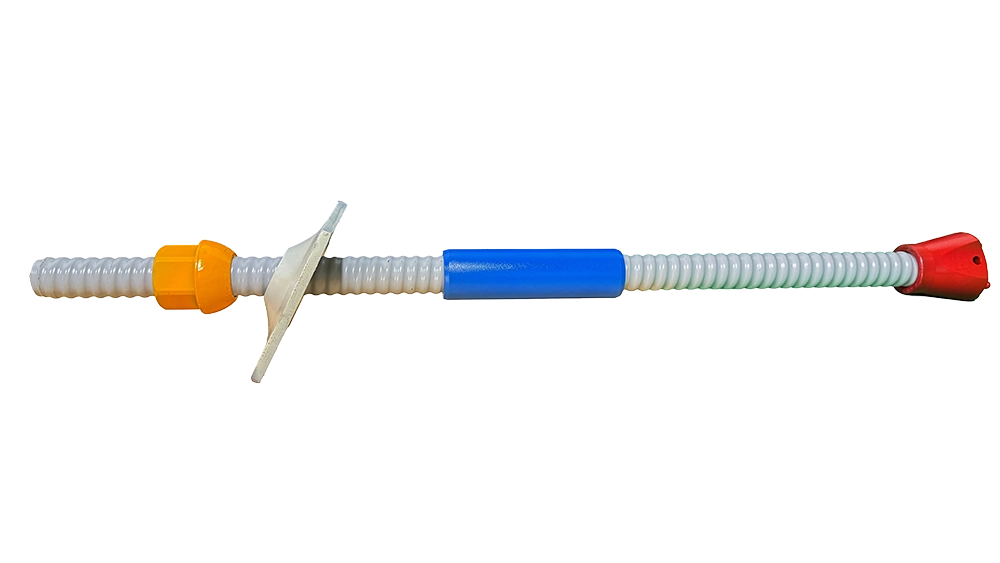
Typical self-drilling anchor assembly: hollow threaded bar, connection coupler, bearing plate, anchor nut and sacrificial drill bit.
One anchor system, multiple components
A self-drilling anchor is not simply a hollow threaded bar. The bar, drill bit, coupler, bearing plate, nut, centralizer, grout, and corrosion-protection method work together as a complete system.
Rayon Threaded Bars
Hollow threaded anchor bars form the main structural component of a self-drilling anchor system. The hollow center provides a passage for flushing and grout, while the external thread allows the bar to connect with couplers, nuts, and other accessories.
Connection Couplers
Couplers connect individual hollow bars when a longer anchor length is required. The coupler must be compatible with the anchor bar thread and capable of transferring the required drilling and structural loads.
Drill Bits
Drill bits determine how the anchor penetrates the ground and must be selected according to the formation and the required drilling diameter. Bit designs can include carbide-tipped options and other configurations for different soil and rock conditions.
Bearing Plates and Nuts
Bearing plates distribute the anchor load over the supported surface, while anchor nuts secure the plate and transfer tensile force from the anchor bar into the structure.
Centralizers
Centralizers help keep the hollow bar positioned within the borehole and can improve grout coverage around the reinforcement element.
Injection Grout
Cement-based grout is injected through the hollow bar and fills the borehole and surrounding ground. Grout pressure and mix design should be selected according to the ground conditions and project requirements; working pressure may vary by installation method and application.
Corrosion Protection
For permanent installations, corrosion protection should be selected according to the ground environment, design life, project specification, and applicable standards. Thermal-diffusion galvanizing can be used as a corrosion-protection option where the required system and service conditions permit.
Assembly and Installation
Successful installation of a ground anchor depends on soil properties, groundwater conditions, estimated embedment depth, required load-bearing capacity, drilling method, grout design, and the selected anchor type. Several installation approaches are available, and the method should be matched to the ground and project requirements.
Site Data
Collect geological information, groundwater conditions, expected loads, and the required design service life.
Drilling
Drill to the required embedment depth using a suitable conventional or self-drilling method.
Grouting
Inject grout through the borehole or, for SDA systems, through the hollow anchor bar.
Anchor Head
Install the bearing plate and nut and verify compatibility with the selected bar system.
Testing
Where required, apply a tensile test and compare displacement with the applicable acceptance criteria.
Collecting Initial Data
The first step always involves collecting initial data. Geological surveys help determine the underlying strata, the presence of groundwater, and the characteristics of the soil or rock. The engineer then performs calculations based on the expected loads and selects the appropriate length, diameter, material, and anchor configuration.
Bored-and-Injection Installation
Many projects use a bored-and-injection method in which an anchor element is installed into a drilled hole and the surrounding space is filled with cement-based grout. Grouting can improve the bond between the reinforcement and the surrounding ground and can create a consolidated anchorage zone. This approach is particularly important in deep excavations and heterogeneous ground where conventional piling or unsupported open boreholes may be difficult.
Self-Drilling Installation
With a self-drilling anchor, the hollow threaded bar itself acts as the drill string. The sacrificial drill bit is attached to the end of the bar, allowing the anchor to be drilled into the ground while the hollow bar remains in position. Flushing and grout can be passed through the hollow bar, integrating drilling, grouting, and permanent reinforcement into a continuous installation process.
Self-Expanding Installation
Self-expanding structures are convenient where quick work is required and the soil allows the anchor to be driven using pneumatic or hydraulic equipment. Once the desired depth is reached, the root plates are expanded to provide mechanical anchorage in the ground. The suitability of this method depends strongly on the ground conditions and anchor design.
Anchor Testing
An important rule of engineering practice is to test the anchor after installation where testing is required by the project specification. A hydraulic jack can apply a tensile force while displacement is recorded and compared with the applicable acceptance criteria. If the results are satisfactory, the anchor can be placed into permanent service.
Advantages of Ground Anchors
Ground anchors can make the underground portion of a project safer and more reliable by providing additional stability to the overall structure. This approach is especially valuable when work is being carried out near existing buildings or in challenging geological conditions.
High Reliability
When properly calculated, installed, and subject to appropriate quality control, ground anchors can provide dependable long-term reinforcement.
Resource Savings
Anchoring can reduce the amount of large-scale structural work required, particularly for retaining systems where massive structures would otherwise occupy significant space and consume more material.
Reduced Construction Time
Ground anchors can be attractive compared with traditional retaining walls or pile rows. Self-drilling systems can further integrate drilling, grouting, and reinforcement installation.
Flexible Installation Options
Driven, bored, screw, and self-drilling approaches provide different installation options for different ground conditions and project requirements.
Reliable fastening during service
Properly designed and installed anchoring systems can help control foundation movement, wall displacement, slope deformation, and other undesirable phenomena caused by external loads or ground instability.
How to Choose the Right Ground Anchor?
There is no single ground anchor suitable for every project. Selection should begin with the ground and structural requirements rather than the anchor diameter alone.
- Ground and geological conditions — soil, rock, fractures, groundwater, and borehole stability.
- Required tensile or pull-out capacity — based on the engineering design and applicable standards.
- Embedment depth and bond length — determined from ground conditions and the required anchorage.
- Borehole and drill-bit diameter — matched to the selected anchor system and ground formation.
- Grouting method — grout type, mix, pressure, and injection procedure.
- Corrosion protection and service life — based on exposure, project specification, and design requirements.
- System compatibility — hollow bar, drill bit, coupler, nut, bearing plate, and other accessories should work as one complete system.
R32, R38, R51 and T76 should not be selected by diameter alone. A complete engineering decision also considers the steel section, thread configuration, design load, drilling conditions, grout body, bond characteristics, installation equipment, and project standards.
Ground Anchor vs. Self-Drilling Anchor
“Ground anchor” is a broad engineering term covering several anchoring technologies. A self-drilling anchor is a specific hollow-bar system in which the anchor bar functions as the drill string during installation and remains in the ground as permanent reinforcement.
| Feature | Conventional ground anchor | Self-drilling anchor |
|---|---|---|
| Drilling | Normally completed before reinforcement installation | Hollow anchor bar acts as drill string |
| Drill rod | Separate drilling tool | Hollow anchor bar |
| Grouting | Usually a separate operation | Can be performed through the hollow bar |
| Permanent reinforcement | Installed after drilling | Anchor bar remains in the ground |
| Difficult ground | May require additional drilling measures | Particularly useful in many unstable or fractured formations |
The main advantage of self-drilling anchors is therefore not simply faster drilling. Their key benefit is the integration of drilling, grouting, and permanent reinforcement into one installation sequence, which can be valuable when maintaining a conventional open borehole is difficult.
Frequently Asked Questions
What is a ground anchor?
What is a self-drilling anchor?
What is an R32 self-drilling anchor?
What is an R38 self-drilling anchor?
What is an R51 anchor bolt?
What is a T76 self-drilling anchor?
Are R32, R38, R51 and T76 interchangeable?
Which self-drilling anchor should I choose?
Conclusion
Ground anchors provide an effective way to transfer tensile forces from structures into surrounding soil or rock. Different technologies are available, including rod anchors, strand anchors, self-expanding anchors, screw anchors, injection anchors, and self-drilling anchor systems.
Among these technologies, self-drilling anchors provide a practical solution for many difficult ground conditions because the hollow threaded bar acts as both the drill string and permanent reinforcement, while grout can be injected through the bar during installation.
Common self-drilling anchor models include R32, R38, R51 and T76. R32, R38 and R51 are R-thread hollow bar systems, while T76 belongs to the T-thread family. The appropriate model should be selected according to the required load, ground conditions, drilling diameter, grouting requirements, corrosion protection, and project specifications.
A complete self-drilling anchor system does not consist of the hollow bar alone. Drill bits, couplers, bearing plates, nuts, centralizers, grout, and corrosion-protection measures all contribute to the performance of the completed system.
Looking for a specific SDA size?
Explore the R-thread and T-thread hollow bar ranges and match the anchor bar with compatible drill bits, couplers, nuts, and bearing plates for your project requirements.

