
Ground Anchor Systems: Components, Functions, and Installation Guide
Introduction
Ground anchors are essential in construction, drilling, and mining projects for stabilizing soil and rock.
They provide quick and efficient construction while ensuring structural reliability and stability.
Popular systems include:
DYWIDAG’s DYWI® Drill Hollow Bar System, THREADBAR® Anchors, GEWI® Piles,
ISCHEBECK’s TITAN micropiles, and
Epiroc (formerly Atlas Copco) Self-Drilling Anchor rock bolts.
While specifications differ between brands, the principles and overall structure are largely similar.
This article explains the main components of ground anchor systems, their design, installation process, applications, and testing.
Key Components of a Ground Anchor System

Transfers load to the supporting node.
Distributes force to the supported structure.
Connects multiple anchor bars together.
Centralizer
Keeps the reinforcing element centered in the borehole, ensuring uniform cement coverage.
Anchor Bar / Full-Thread Drill Bar
Main reinforcing element.
Breaks rock and soil during drilling.
Ground Anchor System Design
A ground anchor typically consists of three main parts:
- The Head – Transfers load to the anchor tie rod.
- The Anchor Tie Rod – Transfers load from the head to the root.
- The Root Seal – Transfers load from the rod into the ground.
After installation, injection mortar is poured into the cavity. To protect against corrosion, the rod is coated with a special polymer.
A hollow attachment (drill bit or chisel) is placed at the bottom of the pile to facilitate soil penetration, chosen based on soil characteristics.
At the top of the pile is a support plate secured with domed nuts. In most cases, the cap includes a support plate attached to the strapping belt, along with a direct anchor fastening unit (conical washer and nut).
The pile kit also contains centralizers and couplings:
- Coupler sleeves extend the pile rods
- Centralizers orient the shaft within the borehole
When Are Ground Anchors Used?
Ground anchors prevent excavation walls from collapsing.
- Example: A deep pit needs excavation. Sloping walls may not be possible if the site is surrounded by buildings or infrastructure like tram tracks.
- Solution: Secure the enclosing structure with ground anchors.
Applications of Ground Anchors
Ground anchors:
- Reduce settlement of surrounding buildings
- Simplify excavation compared to strut systems
Common applications:
- Excavations: Stabilize walls, slopes, and embankments
- Foundations: Stabilize tall buildings and bridges
- Transport Infrastructure: Roads, tunnels, railways, highways
- Hydraulic Structures: Dams, weirs, and water-retaining structures
Types and Fastening of Anchors
Materials used as anchor bolts include:
- Rod anchors
- Helical bolts
- Reinforcing bars
- Self-drilling anchor bolts / Hollow drill rod anchors (Titan, Atlas, DYWI, etc.)
- Strand anchors
- Metal cables for cable anchoring
The anchor root is formed by injecting cement mortar under pressure.
Ground Anchor Installation Process
Required Equipment:
- Drilling rig
- Cement injection pump
- Mixing station for cement slurry
- Cement storage silo
- Water tank
1. Drilling and Grouting
Drill to the design depth using a cement slurry with a water-to-cement (W/C) ratio of approximately 0.8.

2. Securing the Anchor and Load Testing
Dynamic well testing is performed using a thicker cement slurry with a W/C ratio of around 0.5 to ensure proper load capacity.
Note: W/C ratio = Water-to-Cement ratio

3. Ground Anchor Testing and Specifications
- After installation, each anchor must be tested to confirm the design load
- Only after confirming the load can the anchor be permanently secured (anchor locking)
- Anchor tie-rod sizes ensure high load-bearing capacity for soil and material
- Accessories should exceed the design load of bars
Self-Drilling Anchors and Drill Hollow Bars
For self-drilling anchors or drill hollow bars, drilling and grouting are completed in a single step.
This method saves time and is especially suitable for weak soil or rock conditions, increasing project feasibility and efficiency.

Conclusion
Ground anchors are critical in modern construction, civil engineering, and infrastructure projects.
By understanding components, installation, testing, and applications, engineers can ensure stability, reliability, and efficiency even under challenging soil and urban conditions.
Explore our full range of ground anchor systems and accessories—contact us today for technical guidance or an e-catalog.
 https://i0.wp.com/rayonsda.com/wp-content/uploads/2026/10/Self-Drilling-Anchor-Hollow-Bar-System.webp?fit=1000%2C800&ssl=1
800
1000
RY
https://rayonsda.com/wp-content/uploads/2026/03/Rayon-Logo-300x138.png
RY2026-10-19 06:36:452026-10-20 02:13:02Self Drilling Anchor HOLLOW BAR System
https://i0.wp.com/rayonsda.com/wp-content/uploads/2026/10/Self-Drilling-Anchor-Hollow-Bar-System.webp?fit=1000%2C800&ssl=1
800
1000
RY
https://rayonsda.com/wp-content/uploads/2026/03/Rayon-Logo-300x138.png
RY2026-10-19 06:36:452026-10-20 02:13:02Self Drilling Anchor HOLLOW BAR System https://i0.wp.com/rayonsda.com/wp-content/uploads/2026/09/ground-anchor-cover.webp?fit=1000%2C800&ssl=1
800
1000
RY
https://rayonsda.com/wp-content/uploads/2026/03/Rayon-Logo-300x138.png
RY2026-09-09 06:19:592026-09-09 06:20:02Ground Anchor Types and Installation Technologies
https://i0.wp.com/rayonsda.com/wp-content/uploads/2026/09/ground-anchor-cover.webp?fit=1000%2C800&ssl=1
800
1000
RY
https://rayonsda.com/wp-content/uploads/2026/03/Rayon-Logo-300x138.png
RY2026-09-09 06:19:592026-09-09 06:20:02Ground Anchor Types and Installation Technologies https://i0.wp.com/rayonsda.com/wp-content/uploads/2026/07/natm_tunnel_cover.webp?fit=1000%2C800&ssl=1
800
1000
RY
https://rayonsda.com/wp-content/uploads/2026/03/Rayon-Logo-300x138.png
RY2026-07-20 03:33:432026-07-20 03:33:45How the New Austrian Tunnelling Method Changed Underground Construction — And Why Self-Drilling Anchors Matter
https://i0.wp.com/rayonsda.com/wp-content/uploads/2026/07/natm_tunnel_cover.webp?fit=1000%2C800&ssl=1
800
1000
RY
https://rayonsda.com/wp-content/uploads/2026/03/Rayon-Logo-300x138.png
RY2026-07-20 03:33:432026-07-20 03:33:45How the New Austrian Tunnelling Method Changed Underground Construction — And Why Self-Drilling Anchors Matter https://i0.wp.com/rayonsda.com/wp-content/uploads/2026/06/galvanized_anchor_cover.webp?fit=1000%2C800&ssl=1
800
1000
RY
https://rayonsda.com/wp-content/uploads/2026/03/Rayon-Logo-300x138.png
RY2026-06-30 06:56:502026-06-30 06:56:52
https://i0.wp.com/rayonsda.com/wp-content/uploads/2026/06/galvanized_anchor_cover.webp?fit=1000%2C800&ssl=1
800
1000
RY
https://rayonsda.com/wp-content/uploads/2026/03/Rayon-Logo-300x138.png
RY2026-06-30 06:56:502026-06-30 06:56:52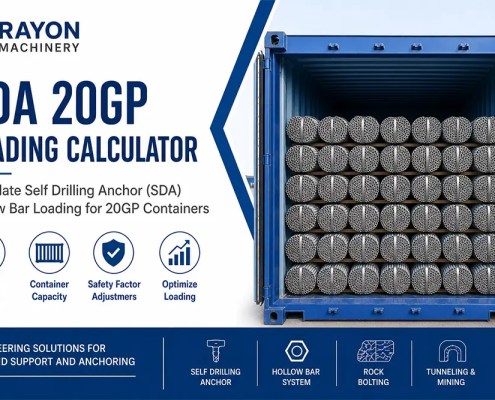 https://i0.wp.com/rayonsda.com/wp-content/uploads/2026/06/SDA-Container-Loading.webp?fit=1000%2C667&ssl=1
667
1000
RY
https://rayonsda.com/wp-content/uploads/2026/03/Rayon-Logo-300x138.png
RY2026-06-01 06:59:172026-09-03 07:32:10Self Drilling Anchor Container Loading Guide (20GP Calculation Method)
https://i0.wp.com/rayonsda.com/wp-content/uploads/2026/06/SDA-Container-Loading.webp?fit=1000%2C667&ssl=1
667
1000
RY
https://rayonsda.com/wp-content/uploads/2026/03/Rayon-Logo-300x138.png
RY2026-06-01 06:59:172026-09-03 07:32:10Self Drilling Anchor Container Loading Guide (20GP Calculation Method) https://i0.wp.com/rayonsda.com/wp-content/uploads/2026/05/Prestressed-Anchors.webp?fit=1000%2C800&ssl=1
800
1000
RY
https://rayonsda.com/wp-content/uploads/2026/03/Rayon-Logo-300x138.png
RY2026-05-21 01:34:102026-05-21 01:34:12Prestressed Anchors and Gravity Walls in Action
https://i0.wp.com/rayonsda.com/wp-content/uploads/2026/05/Prestressed-Anchors.webp?fit=1000%2C800&ssl=1
800
1000
RY
https://rayonsda.com/wp-content/uploads/2026/03/Rayon-Logo-300x138.png
RY2026-05-21 01:34:102026-05-21 01:34:12Prestressed Anchors and Gravity Walls in Action
